Seamless vs. Sectional Gutters: What a Seam Every 10 Feet Really Costs You
The joint between two pieces of gutter is where most leaks, drips and sagging begin.
October 12, 2026 · 4 min read
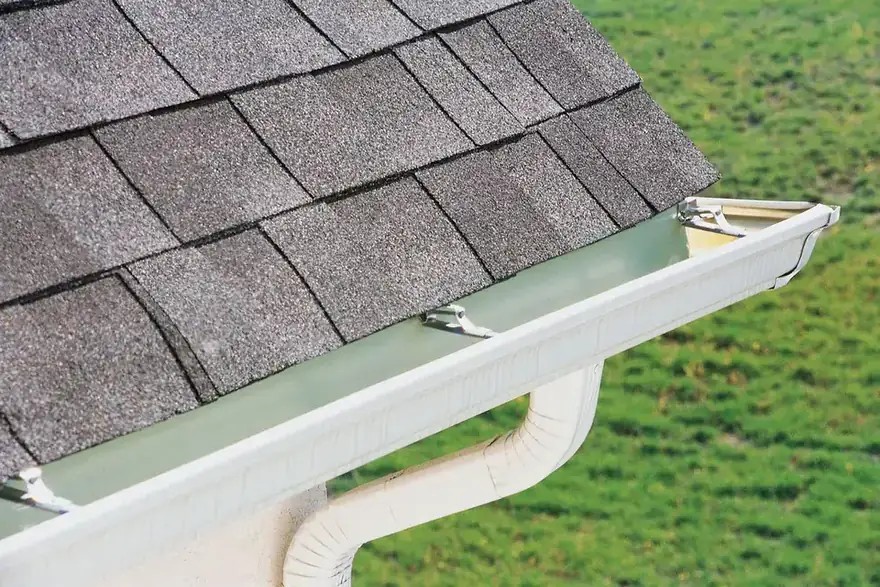
Walk around an older neighborhood in Dodge County or Fond du Lac County and look up at the gutter line. On a lot of houses you can spot the joints: small vertical lines, sometimes a dab of dried sealant, sometimes a drip stain on the siding right below. Those joints are the whole reason homeowners start asking about seamless gutters, so it is worth understanding what they are and what they do.
What a sectional gutter actually is
Conventional gutters are made from several pieces of material, which means a seam about every 10 feet. Each piece is joined to the next with a connector and sealed. On a house with a long run along the front, that adds up to a handful of joints before you even count the corners and the places where the downspouts attach.
A sealed joint is fine on the day it goes up. The trouble is that a gutter is not a still object. It fills with water, drains, warms in the afternoon sun and cools overnight. In a Wisconsin winter it also takes on snow and ice. Metal expands and contracts through all of that, and a seam is the one spot where two separate pieces have to move against each other while a bead of sealant keeps them watertight. Over the seasons that seal can crack, pull away, or simply let go.
What seamless means
Seamless gutters are made from one continuous roll of heavy gauge aluminum, so the run along your roofline has no seams in it. What is left are the corners and the openings where water drops into the downspouts. Instead of a joint every 10 feet that has to hold, there is one unbroken channel carrying the water to where it is supposed to go.
That is why seamless gutters help protect against leaks, breakage and sagging. It is not magic. It is just fewer places for something to go wrong. A gutter you never have to think about is the goal, and removing the weakest point in the system is the most direct way to get there.
How seams fail in real life
Nobody wakes up and notices that a seam has failed. It usually shows up as a symptom somewhere else. Here are the signs that tend to point back to a joint:
- A slow drip along the underside of the gutter, often most obvious a few minutes into a hard rain.
- Dark streaks or stained boards on the fascia or siding directly below a joint.
- Sealant that has dried out and cracked, leaving a visible gap you can sometimes see from the ground if you know where to look.
- A section that sags, where the weight of water or ice pulls on a weak joint and the run starts to tilt away from the house.
- Pieces pulled apart after a heavy ice load, where the connector gave way before the metal did.
Water that leaks at a seam never reaches the downspout. It lands on the wall, on the soil next to the foundation, or in your flower bed. A drip that seems harmless in July can turn into a soaked fascia board by spring, and patching a joint tends to be a job you repeat, because the joint is still there afterward.
Why it matters more in Wisconsin
Around Brownsville, Mayville and Waupun, a gutter goes through a full set of seasons. Heavy fall rain, leaves, a long freeze, snow piled on the roof, and then a thaw that sends all of it through the system at once. Every one of those swings works on the joints. A seamless run does not make the weather easier, but it takes away the part of the gutter that the weather is best at breaking.
It also looks cleaner. A continuous run has a sleek, uninterrupted line along the eave, and seamless gutters come in styles and colors to match your home. When you are putting new gutters on a house you have worked hard to keep up, that matters.
Seamless does not fix everything, and it would be wrong to say so. A seamless gutter still has to be hung securely and pitched so water runs toward the downspouts. It still needs to be kept clear. A perfectly seamless run full of wet leaves will overflow just like any other gutter. Seamless takes one common failure point off the table. It does not do the rest of the job for you, which is why it pairs well with careful installation and, on houses with a lot of trees, with gutter guards or regular cleaning.
What to look at on your own house
Next time it rains, put on a coat, step outside and watch your gutters for a minute. Water spilling over at a joint instead of going into the downspout, drips along the underside, or a gutter that dips in the middle are all worth noting. Check the siding and fascia below for streaks or staining. None of this needs a ladder, and it gives you something concrete to describe when you talk to a contractor.
If your gutters are leaking at the seams or sagging along the roofline, Gutter Rite Seamless Gutters in Brownsville can take a look. Call (920) 979-3483 or request a free estimate and a representative will contact you the same business day.
Gutter Rite Seamless Gutters, (920) 979-3483
Call (920) 979-3483More articles
Do You Need Gutter Guards? What They Do and What They Leave Behind
A good gutter cover cuts down the cleaning, but it does not cancel the whole job.
What Clogged Gutters Do to a House, and Why Cleaning Them Is a Pro Job
Water that cannot get through the gutter finds another way down, and it is rarely a good one.